


Electronics · A VIEOX perspective
Build the television around the display it actually uses.
Explore television manufacturing through panel handling, module integration, optical inspection, firmware and final interface verification.
The practical question
What should manufacturers control when assembling modern televisions?
Define the display architecture and approved module combination first. Protect the panel through handling and enclosure assembly, verify board and cable integration, and assess optical quality under controlled conditions. Complete the product's interface, audio, software and release checks. Television-set assembly needs its own controls even when the display module and circuit boards arrive already tested.
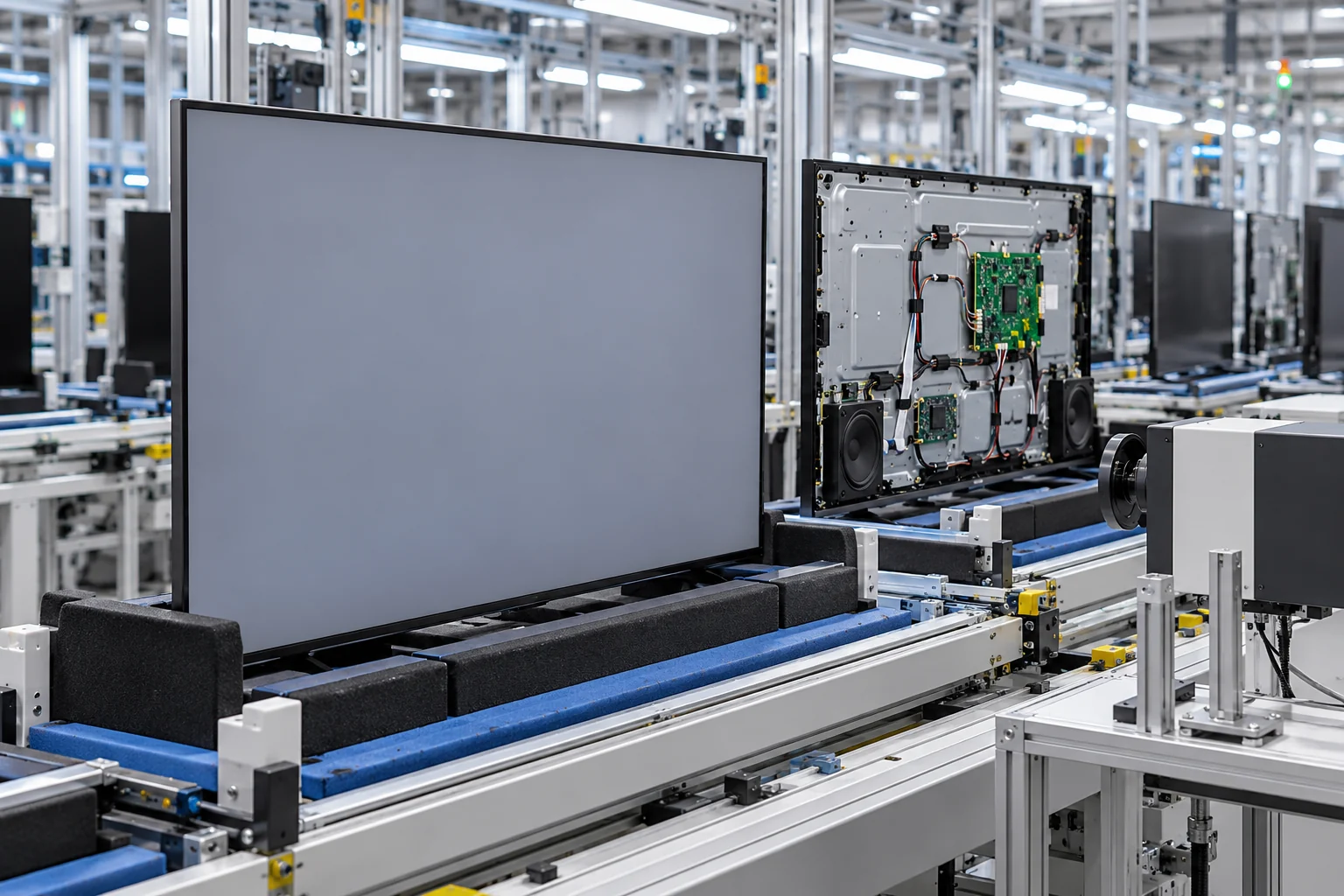
Television-set assembly brings together a large display, control and power electronics, sound, connectivity and an enclosure. A clear picture on first power-up is only one milestone. The manufacturing route must also protect the panel, match the installed modules and verify the functions promised for that particular model.
Choose the route for the actual display architecture
This perspective concerns assembling a television from modules and components; manufacturing the display panel itself is a separate upstream process. LG's technology explanation identifies organic light-emitting diode (OLED) displays as self-emissive and therefore without a separate backlight. A liquid-crystal display (LCD) television instead needs the backlight appropriate to its design.
The distinction changes the parts, assembly operations and checks that belong on the route. Establish whether the site receives a complete display module or assembles additional optical and lighting parts. Keep the panel, controller, power supply and firmware combination within the approved model configuration; matching screen size alone does not establish compatibility.
Sources: [1]
Treat panel handling as a production operation
Define approved carriers, support points and transfer methods for each panel family using its supplier's handling instructions. Review where the panel is unpacked, turned, supported and moved into the chassis. A handling method that worked for one size should be checked before being extended to a larger or thinner module.
Inspect the panel and accessible surfaces at the agreed incoming and assembly stages. Keep protective films, cleaning materials and contamination controls consistent with the supplied module. Record damage when it is found, including the stage and location, rather than automatically assigning every scratch or display mark to the final operator. Rejected material needs an explicit disposition.
Check the connections before the enclosure hides them
The main board, power board, speakers, wireless module and display connections must form the intended product. Confirm connector seating, cable routing, shields, thermal interfaces and fastening operations against the approved assembly instructions. Where an LCD route includes backlight integration, verify the correct lighting and optical parts without assuming the same arrangement applies to OLED models.
Place useful verification before covers make the connections inaccessible. A recorded fastening result should identify the joint and tool programme it represents. A connector-presence image should show the feature actually used for acceptance. Neither record should be interpreted as a complete electrical test of the connection or the finished set.
Measure the picture under defined conditions
Radiant Vision Systems describes display inspection for brightness and colour uniformity, pixel and line defects, light leakage and uneven visual patterns often called mura. These are different quality questions. A test showing that the panel illuminates does not answer all of them.
Use the model's approved test patterns, image settings, measurement geometry and acceptance criteria. Preserve the relevant environmental and stabilisation conditions so comparisons remain meaningful. Identify whether a finding is a panel feature, an assembly-related change or an inspection-system concern before choosing an action. Keep any calibration or image-processing correction separate from the original observation and its acceptance decision.
Sources: [2]
Exercise the interfaces the customer will use
Build the final test around the model's supported functions: selected video inputs, sound channels, remote controls, network connections and relevant tuner or regional features. Verify the installed software and configuration against the intended market. The production plan should say what is checked on each unit and what belongs to separate design or sampled validation.
HDMI Licensing Administrator identifies authorised centres for formal HDMI compliance testing. A factory check that displays a picture through an HDMI port has a narrower purpose. Keep the product's formal qualification evidence distinct from routine assembly checks, and review affected coverage when a board, connector, software build or supported feature changes.
Sources: [3]
Follow a finding back through the assembly stages
Hypothetical example: an LCD television family shows more uneven illumination after rear-cover assembly. The team compares the same approved optical test before and after closure, then reviews panel batches, support arrangements, cable routing and fastening records. It verifies the inspection setup before attributing the pattern to a supplier or one assembly operation.
The quality team controls affected units while engineering evaluates the plausible causes through an authorised trial. The review considers accepted sets and extra handling, not only assembly speed. A useful improvement leaves a clearer instruction and a verified comparison for the next build, with any remaining uncertainty visible to the people releasing the product.
Put the question to work
A practical checklist
- Define whether the route uses LCD, OLED or another display architecture.
- Match the panel and electronics to the approved model configuration.
- Verify panel support, transfers and accessible connections before closure.
- Keep optical patterns, settings and inspection conditions consistent.
- Check the interfaces and software intended for the destination market.
- Separate routine unit checks from formal product qualification.
Questions, answered
Does a supplied display module remove the need for final optical inspection?
The product's inspection plan should account for the operations that follow receipt. Handling, integration and enclosure assembly introduce additional questions. Supplier evidence and finished-set checks should have defined responsibilities and coverage rather than an assumed equivalence.
Should all television sizes share one assembly programme?
Shared equipment can support several sizes, but handling supports, module combinations, fastening operations and test geometry need the appropriate approved setup. A common product family does not make every physical configuration interchangeable.
Can a brighter test image hide an optical defect?
Changing image settings can change what an inspection reveals. Use the authorised patterns and settings, retain the original finding and resolve it through the quality process. Changing the test merely to obtain a pass does not establish an acceptable product.