


Electronics · A VIEOX perspective
Test appliance electronics in the machine they must control.
Explore home-appliance manufacturing through control boards, motors, sensors, wiring harnesses, software and verification of the finished appliance.
The practical question
How should manufacturers verify electronics integrated into home appliances?
Confirm the controller and software variant, inspect the installed sensors and wiring, and test the functions that depend on their interaction with the appliance. Separate board checks, simulated input tests and finished-product verification. Use the approved product-specific functional and safety plan so a board-level pass is not mistaken for acceptance of the complete machine.
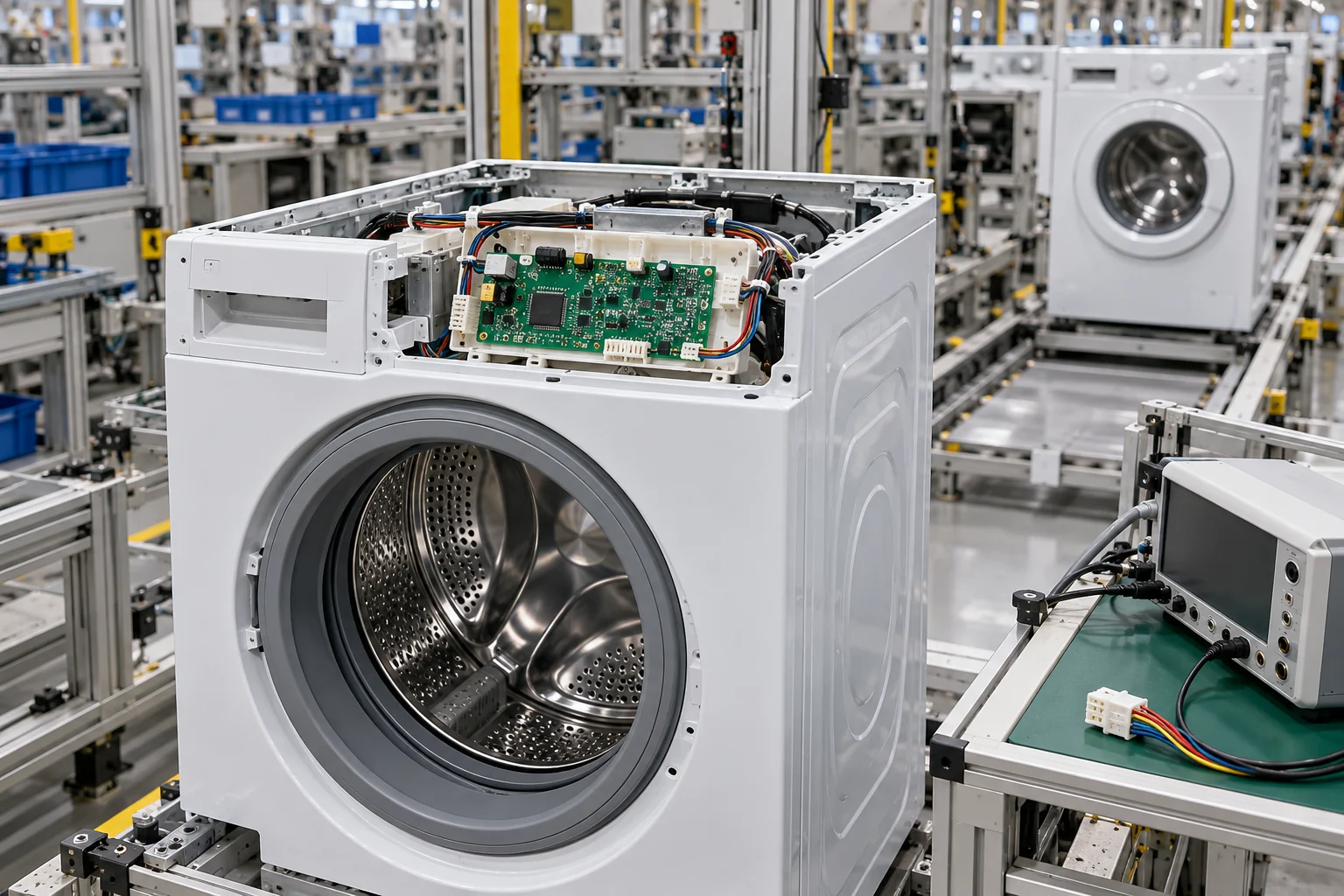
A washing machine, refrigerator or cooking appliance is an electromechanical system. Its controller must interpret physical conditions and operate the correct loads through the installed wiring. Manufacturing therefore needs to connect board quality with sensor installation, harness assembly and verification of the complete appliance, rather than stopping at a controller that powers up.
Begin with the physical jobs the controller performs
Texas Instruments' appliance-sensing brief describes sensors for conditions such as water level, selector position and temperature, with electronic controls using that information. This makes the manufacturing question concrete: which installed input tells the controller what is happening, and which output should respond in this product variant?
Create a function map for the appliance family. A washer's fill, drain and drum functions differ from a refrigerator's cooling, defrost and fan functions. Identify the relevant boards, sensors, loads and software configuration for each. The map helps place inspections and tests where they can examine a specific connection between the electronics and the machine.
Sources: [1]
Give control and power electronics the right checks
TI's TIDA-010265 reference design illustrates a washing-machine motor drive combining a controller with a power stage and motor-control software. It is a useful example of why a populated board is only one part of the operating system. A reference design is not evidence that a finished appliance has been qualified.
Verify the approved board revision, components, programming and applicable electrical tests before installation. Where a family uses separate user-interface, main-control and motor-drive boards, confirm their compatibility. Keep power-stage checks within the authorised test arrangement. Matching connectors or a normal indicator light do not establish that the controller can safely operate the intended motor or other load.
Sources: [2]
Treat the wiring harness as part of the product
A wiring harness carries power and signals between the controller and the appliance. Verify its part identity, routing, connector engagement, retention and protection at the stages where these remain visible. Where the design specifies protective bonding, insulation barriers or separation of circuits, confirm those features through the approved assembly and inspection process.
Plan checks around moving parts, access covers and the final enclosure. A correct continuity result before installation does not establish that a cable was subsequently routed or secured correctly. Record the actual assembly condition, and retain the required fastening or inspection evidence without treating a tool's completion signal as proof of every downstream requirement.
Distinguish a simulated input from the installed sensor
A board fixture can present a simulated temperature or switch state to test the controller's response. That is useful coverage, but it does not establish that the actual sensor is fitted in the correct location, connected through the intended harness or responding to the physical condition it is meant to observe.
Define how the production plan verifies those remaining questions. Depending on the product, the check may concern sensor seating, orientation, a pressure connection, door state or an observed response during an approved sequence. Retain the distinction between a simulated condition and a physical observation. Apply calibration only where specified, with a method and acceptance basis appropriate to that sensor.
Finish with the appliance's approved verification plan
IEC's public description of IEC 60335-1 identifies its scope as the safety of household and similar electrical appliances. It also notes that additional requirements can apply. The public scope explains the subject of the standard; it is not a substitute for the applicable complete requirements or a model-specific production test plan.
Have the responsible specialists define the functional and safety checks for the actual appliance and destination market. Establish which operations run on every unit and which belong to separate validation. Keep interlock and protective-function checks within approved methods. An abbreviated factory sequence should have documented coverage and should not be described as reproducing every condition of normal use.
Sources: [3]
Review the installed system when a board appears responsible
Hypothetical example: a washer family stops during its final functional sequence after a harness change. The controller passes its board test, so the team compares the new harness, connector assignment, installed sensor response and variant configuration against the approved build. It preserves the failed sequence and prevents affected appliances from entering normal release.
The investigation uses controlled checks to separate a wiring issue, a sensor-installation issue and a software mismatch. It does not bypass a protective function to complete the cycle. Following any authorised correction, the team repeats the required affected checks and reviews whether the assembly instructions and variant verification need a lasting improvement.
Put the question to work
A practical checklist
- Map appliance functions to their controllers, sensors and loads.
- Confirm compatible control, user-interface and power-board variants.
- Inspect harness routing and connections before access is restricted.
- Separate simulated inputs from installed-sensor verification.
- Use the approved finished-appliance functional and safety plan.
- Repeat affected checks after an authorised repair or configuration change.
Questions, answered
Does a tested control board make the finished appliance acceptable?
The board result establishes only its defined coverage. Installation adds wiring, sensors, loads, mechanical conditions and product configuration. The finished appliance still needs the checks specified by its approved production and release plan.
Can several appliance models share one final-test sequence?
A common test platform can be useful if the sequence selects the correct model-specific steps, limits and equipment configuration. Any shared sequence still needs evidence that it covers the requirements of each supported variant.
Should a protective-function failure be bypassed for diagnosis?
Use the authorised engineering and safety procedure for investigating the failure. The production route should preserve the failed result and control the affected appliance. Completing a cycle with a protection bypassed does not establish acceptance.