


Electronics · A VIEOX perspective
Automotive and power electronics: connect the assembly to its operating demands.
Follow electronic control units and power-conversion assemblies through approved components, joining, thermal integration, traceability and verification.
The practical question
What should manufacturing teams connect when building automotive and power electronics?
Connect the approved design and component selection with joining, mechanical assembly, thermal integration, firmware and test evidence for each identified unit. Keep component qualification distinct from validation of the completed assembly. Follow the requirements of the actual product and customer, with clear ownership of process changes, test coverage, unresolved findings and release decisions.
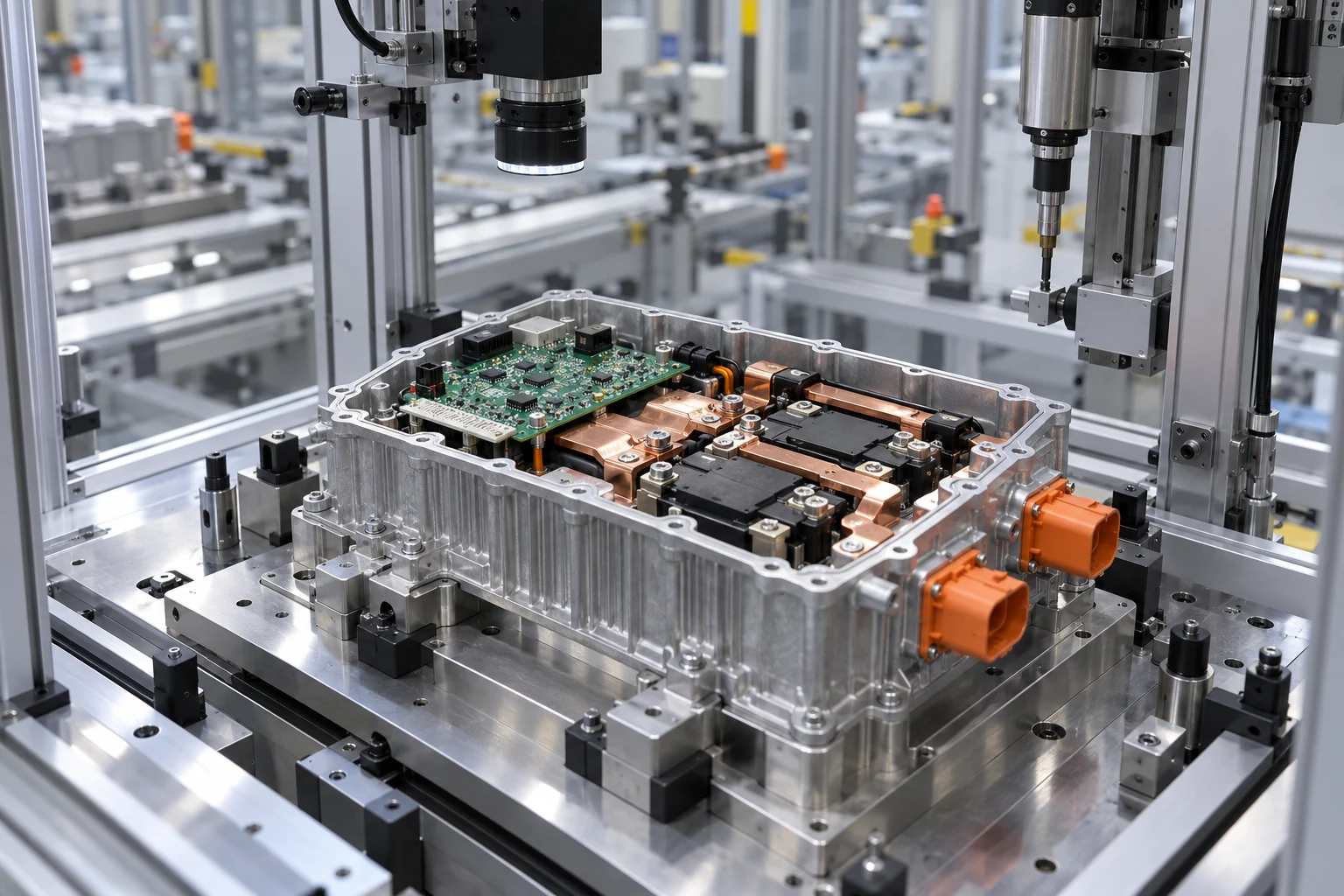
An electronic control unit (ECU), inverter or direct-current-to-direct-current (DC-DC) converter combines electronic, mechanical and software decisions. Building the circuit board is only part of manufacturing the equipment. Connections, cooling arrangements, material choices and the final configuration need to remain visible as the assembly moves towards product-specific verification and release.
Begin with the assembly and its application
Automotive electronics spans more than traction equipment. A body-control ECU, motor inverter and DC-DC converter have different functions, interfaces and operating environments. Power electronics also appears in industrial drives and power supplies. Identify the actual product family before assigning a manufacturing route or copying a test plan from another assembly.
Map the control board, power stage, connectors, current-carrying connections, cooling arrangement and enclosure where present. Record which parts arrive as qualified subassemblies and which are joined on site. A board-level completion count should not conceal unfinished integration, and a shared production cell should not imply identical acceptance requirements for every product it builds.
Keep component qualification within its scope
Renesas describes Automotive Electronics Council AEC-Q100 qualification as a failure-mechanism-based stress qualification for packaged integrated circuits. That scope concerns components; it is not a blanket approval of a complete ECU or power-conversion assembly.
Check the exact ordering code, approved supplier evidence and requirements applicable to each selected part. Keep component changes connected to the engineering review that evaluates their effect on the application. Manufacturing still needs evidence for the assembled product, including its connections, software, thermal arrangement and required tests. Avoid turning a component qualification label into a claim that every end-product requirement has been satisfied.
Sources: [1]
Treat the thermal arrangement as controlled assembly work
Infineon explains, for its HybridPACK 2 module, that mounting affects thermal performance and reliability, while its application note does not replace evaluation of the actual application. This is a product-specific example of why mechanical integration belongs in the manufacturing review.
Follow the approved design for the thermal interface, cooler or heatsink, mounting arrangement and any specified sealing features. Where interface material is required, preserve its identity and relevant application record. Different module designs use different cooling arrangements; do not add a generic interface material or copy a mounting prescription between them. Retain the verification required by the product-specific process.
Sources: [2]
Keep electrical joints and mechanical work traceable
The assembly may contain soldered connections, press-fit contacts, welded conductors or bolted connections. Establish which method is approved for each location and what evidence verifies it. A process-completion signal and a product acceptance decision answer different questions. Preserve relevant tooling or programme revisions, inspection outcomes and authorised exceptions.
Keep current-carrying connections, connector retention, board supports and cable routing within the same controlled history. If a joining programme changes, define the affected units and required review rather than comparing all output as one uninterrupted population. Rework must identify the changed connection or material and the verification that follows, including any subsequent operation it invalidates.
Verify the configuration the product will use
Define the boundary between board tests, subassembly checks and final-equipment verification. Preserve hardware revision, firmware, calibration data where applicable, fixture identity and the relevant test limits. Include the final mechanical and thermal configuration in the coverage review so an earlier pass is not extended beyond the conditions it evaluated.
The approved plan should identify applicable electrical, functional, thermal and other product checks, with the responsible specialists defining the test arrangements. Production tests involving hazardous energy belong in the established controlled test system with qualified personnel. A published operating perspective cannot supply a universal sequence or replace product-specific safety and regulatory assessments.
Use one unit history to investigate a recurring concern
Hypothetical example: an inverter assembly completes its initial functional check, but later shows an unusual temperature response during an approved evaluation. The team compares the identified module, cooling-assembly record, joining history, firmware and actual test conditions. It keeps competing explanations open instead of assuming that the semiconductor or interface material caused the change.
Preserve affected units and observations through the agreed investigation process, then document the finding, authorised action and verification. Extend containment or release only through the responsible quality decision. VIEOX welcomes a discussion about making these records usable across production, engineering and quality, particularly when separate stations each hold only part of the assembly history.
Put the question to work
A practical checklist
- Identify the product family and complete assembly boundary.
- Confirm the exact approved components and their qualification scope.
- Preserve joining and thermal-assembly configurations.
- Link board, power module and finished-equipment identities.
- Keep product-specific test coverage and conditions with each result.
- Control changes, rework and release through named owners.
Questions, answered
Does an AEC-Q100-qualified component make the complete assembly qualified?
No. AEC-Q100 addresses packaged integrated circuits. The complete equipment requires its own applicable design validation, manufacturing controls and acceptance evidence. Component qualification supports that work within its defined scope.
Sources: [1]
Can automotive and industrial power equipment share the same production route?
They may share equipment or selected operations, but their design, customer and operating requirements can differ. Define the route, configuration controls and verification plan for each product rather than assuming that a common line makes them equivalent.
Is a thermal interface material always needed beneath a power module?
Follow the particular module and cooling design. Some arrangements use an interface material and others use different heat-transfer structures. The approved assembly instructions and application evaluation determine what belongs in the product.