


Electronics · A VIEOX perspective
Bring the phone's mechanical, software and radio build together.
Follow mobile phone manufacturing through module assembly, battery integration, firmware, device identity and controlled radio-frequency testing.
The practical question
What makes modern mobile phone manufacturing more than circuit-board assembly?
The completed phone depends on mechanical fit, module compatibility, battery integration, software configuration and radio performance as well as the board itself. Build a route that verifies these dependencies before and after enclosure closure. Keep the intended variant and unit identity consistent through programming, calibration, functional testing and final release.
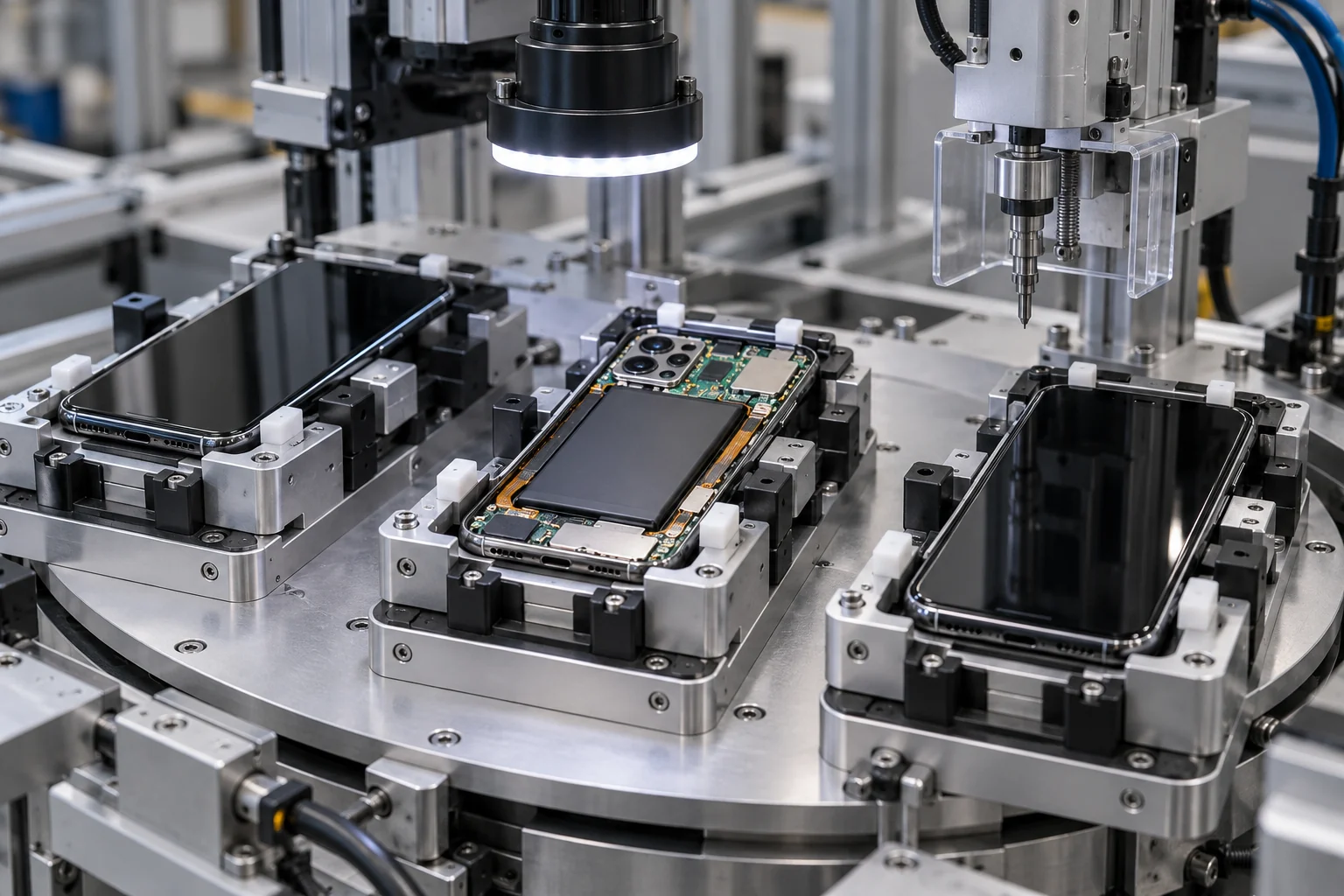
A mobile phone combines precision mechanical assembly with a tightly configured electronic product. Its display, cameras, battery, antennas and software must work together in the finished enclosure. Manufacturing quality depends on controlling that combination through assembly and testing, especially when visually similar variants share the same production line.
Start with a complete build definition
A shared enclosure does not establish that two phone variants use the same parts or software. Confirm the approved combination of main board, display, camera modules, antenna assembly, battery and mechanical parts. Account for storage options and destination-market differences in the build definition rather than relying on a familiar product name.
Prepare the kit and station programmes for that combination. Review how the line handles substitutions, partial kits and units returning from repair. When a component changes, identify the affected fit, calibration and test requirements before release. A successful scan confirms the recorded identifier; it does not independently establish that an unapproved substitution is technically acceptable.
Verify the details that closure makes difficult to inspect
Display and camera placement, flexible-circuit connections, antenna contacts and small fasteners deserve explicit verification points. Follow approved handling and contamination controls for optical surfaces and connection areas. Keep adhesive application, material condition and the required assembly sequence within the product's validated instructions rather than borrowing a recipe from another model.
Plan checks while the relevant features remain accessible. Confirm the mechanical location and connection of each module, then verify the assembled product after closure. If an enclosure has a claimed ingress-protection capability, use the authorised production screening method and its established relationship to product validation. A sealed-looking housing alone cannot substantiate that claim.
Keep battery integration within the approved product design
Murata's laminated lithium-ion battery information explains that its cells are intended for incorporation into finished products with appropriate protective measures. That distinction matters on a phone line: the cell, protection, charging system and mechanical integration belong to an approved combination, not a set of interchangeable parts chosen only by capacity.
Use the supplier and product-specific handling instructions, trained personnel and approved tooling. Verify pack identity and condition at the defined stages, and route suspect or damaged material through the site's battery response process. Preserve the accepted installation and verification record. Production recovery should not depend on improvised cell manipulation or bypassing a protective function.
Sources: [1]
Make programming a controlled manufacturing step
GSMA describes the International Mobile Equipment Identity (IMEI) as identifying an individual mobile device, with the Type Allocation Code forming part of that identity. Keep the manufacturing serial number, authorised device identifiers and relevant board relationship aligned through programming and release. Identity assignment and verification need controlled permissions and exception handling.
Confirm the installed firmware, regional configuration and applicable calibration data against the intended build. Keep a distinction between download completion and successful verification on the device. Where production uses temporary test software or credentials, the release sequence should verify the approved customer state and prevent test configuration from being shipped inadvertently.
Sources: [2]
Give radio measurements their test conditions
Rohde & Schwarz describes production equipment for calibrating and verifying wireless devices in non-signalling mode, using analyser and generator functions. This is a defined radio-frequency (RF) manufacturing assessment, distinct from a person making a call or seeing a wireless-network icon appear on the screen.
For the approved radio test, retain the variant, bands and paths covered, fixture or coupling arrangement, test software and calibration status. Confirm how the method accounts for the assembled antenna and enclosure. Investigate changes to adapters, positioning or shielding before interpreting a sudden yield shift. Routine production testing and formal radio conformance evaluation have different purposes and coverage.
Sources: [3]
Review the finished phone and its exceptions
Complete the model's approved checks for touch, display, cameras, microphones, speakers, buttons, sensors and charging interfaces. Where calibration is required, verify its completion and applicability to the installed module. Packaging should carry the correct unit identity, market information and included accessories, with the product left in its intended shipping state.
Hypothetical example: a camera result changes after a module substitution. The team holds affected units and compares module compatibility, mounting, cleanliness, calibration selection and firmware before blaming the camera supplier. It records the action and the required repeat checks. A later pass does not erase the earlier failure or explain which change resolved it.
Put the question to work
A practical checklist
- Approve the complete module combination for each phone variant.
- Check accessible connections and optical surfaces before closure.
- Follow the specified battery handling and integration process.
- Verify device identity, firmware and applicable calibration data.
- Define radio coverage and control the measurement setup.
- Confirm customer configuration and packaging before release.
Questions, answered
Does a successful call prove the radio assembly is acceptable?
It confirms a particular interaction under the conditions used. The approved manufacturing plan may require additional transmitter, receiver or antenna-related checks across selected configurations. A call test cannot be assumed to replace that defined coverage.
Can one firmware image serve every phone with the same appearance?
Only where the approved product definition supports it. Hardware revisions, modules and market requirements may differ. Verify the installed build against the actual configuration rather than choosing it from appearance or a shortened model label.
What should happen when a phone is reopened after final test?
Use the authorised rework route to identify which previous checks have been affected. Repeat the required verification, including relevant closure or functional checks, while retaining the earlier test history and the reason for reopening.