


Electronics · A VIEOX perspective
PCBA manufacturing: carry the released design through every operation.
Follow printed circuit board assembly from engineering release through mixed assembly, cleanliness, coating, depaneling and final equipment integration.
The practical question
How should a manufacturer control the complete PCBA route?
Start with one released product configuration and define the operations, checks and authorised decisions that apply to it. Preserve material identity and work history across automated and manual stages, including cleanliness and coating where specified. Keep the board linked to its test results, repairs and eventual equipment identity instead of treating placement completion as the end of manufacture.
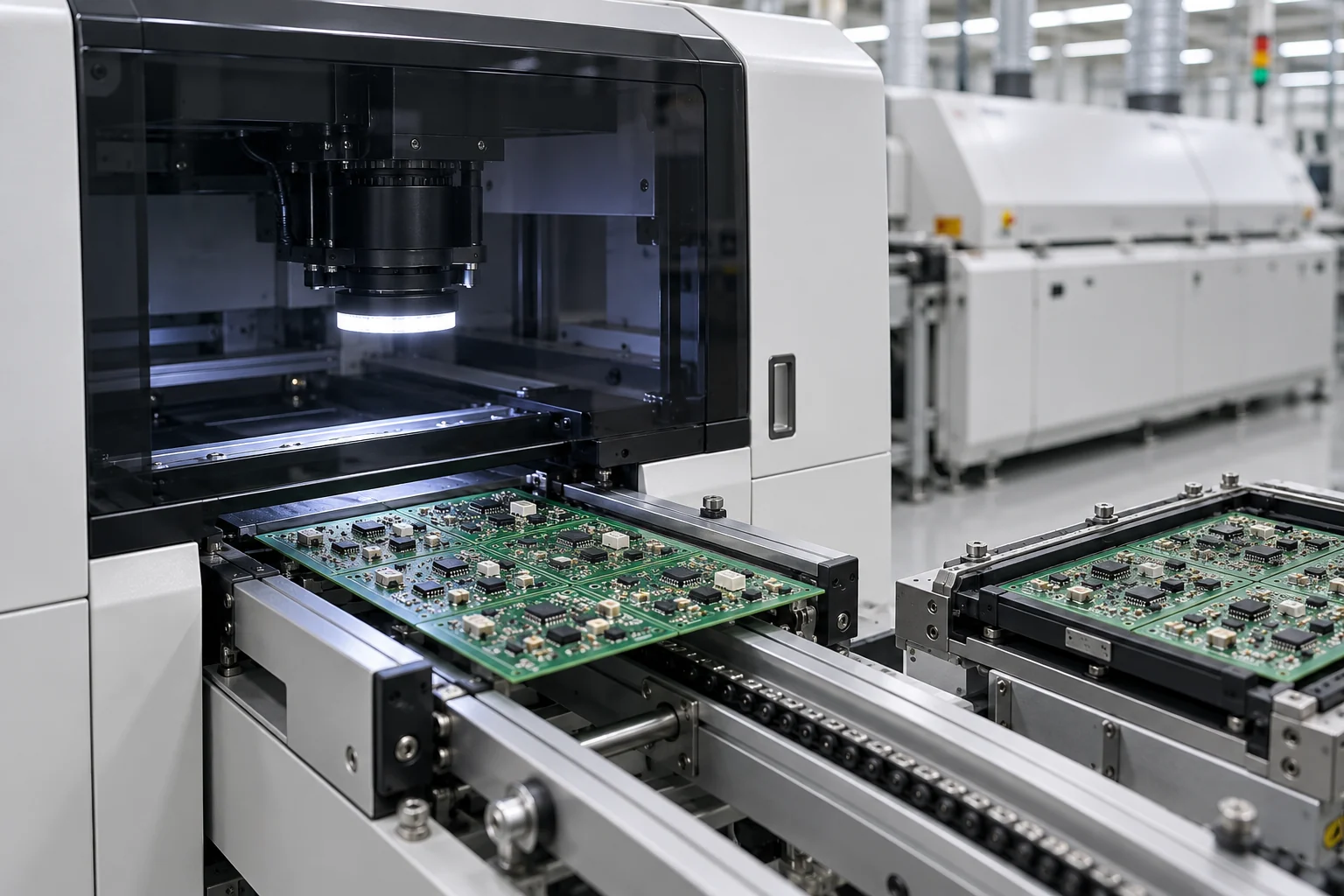
Printed circuit board assembly (PCBA) turns a bare board and a set of components into an electronic assembly. The route may combine automated placement, through-hole soldering, manual work and protective treatments before the board enters finished equipment. A useful manufacturing record follows all of that work, including the operations that happen after the main assembly line.
Give production one build configuration
The public scope of IPC J-STD-001J brings materials, manufacturing methods and acceptance criteria together for soldered electronic assemblies. It illustrates why a work instruction and a final visual check serve different purposes. The applicable standard edition and contractual requirements still need to be established for each product.
Before starting an order, reconcile the bare printed circuit board (PCB) revision, bill of materials (BOM), approved alternatives, assembly drawings and software configuration. Record who can resolve conflicts. A substitute component or updated programme must enter through the agreed engineering process, with a clear boundary for the orders or units affected.
Sources: [1]
Map automated and manual assembly together
Surface-mount components attach to the board surface, while through-hole parts place leads into holes. A mixed assembly may need several joining and handling operations. Define the actual route with the process engineer, including the sequence, tooling, support and verification required at each stage. An automated placement record covers only part of that route.
Bring manual connector fitting, cable attachment and any later soldering into the same history. Preserve the operator instruction revision, relevant equipment setup and exceptions. The separate surface-mount article examines printing, placement and reflow in more detail; here the question is whether a board can leave that line and still carry a complete account of the remaining work.
Make cleanliness and coating product-specific
MicroCare explains that contamination and retained moisture can interfere with conformal-coating adhesion and performance. A coating step therefore cannot be treated as evidence that the surface beneath it was suitable. Where coating is specified, establish the approved preparation, material compatibility and verification requirements with the responsible process specialists.
Record relevant cleaning and drying evidence, coating material identity, application and cure records, and the inspection outcome. Keep designated uncoated areas and approved repairs traceable to the drawing. A material advertised for one assembly does not establish suitability for another. Choose requirements from the product and qualified process rather than imposing coating on every board.
Sources: [2]
Preserve the board when its physical form changes
Depaneling separates individual boards from the manufacturing panel. Define the approved method, support arrangement and checks needed for the specific assembly. Keep the relationship between each panel position and the resulting board identity, especially when boards are separated before their permanent labels are attached.
Review subsequent handling as part of the route. Board supports, connectors, fasteners and thermal interfaces may be fitted before the assembly enters an enclosure. Preserve the work instruction and verification record for those steps. A panel-level pass should not silently become evidence for an operation completed later on only some of its boards.
Connect board testing with equipment integration
Identify which checks apply to the populated board and which require the assembled equipment. The test sequence may depend on firmware, fixtures, cables or loads that differ from the final configuration. Record those differences explicitly and confirm which results remain applicable after the next operation.
Hypothetical example: a control board passes its board-level test, but the completed instrument has an intermittent external connection. The review joins the board serial, connector-fitting record, enclosure assembly and final test attempts. It examines the handovers without assuming that the earlier pass cleared every later operation. The inspection and functional-test article explains how to preserve the meaning of each attempt.
Release an assembly with a usable history
Before release, reconcile completed operations, outstanding findings, authorised deviations and required approvals. Keep rework as an addition to the record, with the changed material or configuration and the verification that followed. Make the final accepted state distinguishable from the route taken to reach it.
Review one recurring concern across the entire route: repeated connector work, waiting for coating inspection or difficulty matching boards to finished units. Assign an owner who can bring the relevant teams together. VIEOX welcomes a conversation about connecting that evidence so the next shift or quality investigation begins with a reliable account of what happened.
Put the question to work
A practical checklist
- Release board, BOM, instructions and software as one configuration.
- Include automated, through-hole and manual work in the route.
- Apply cleanliness and coating controls where the product requires them.
- Preserve panel-to-board identities through depaneling.
- Distinguish board testing from finished-equipment verification.
- Close deviations and rework through the responsible release process.
Questions, answered
Are PCB and PCBA interchangeable terms?
A PCB is the bare printed circuit board; a PCBA is the board with its components assembled. Keeping the terms distinct helps define supplier responsibilities, inspection scope and the handover into equipment integration.
Does every assembly require conformal coating?
No. The product design, environment and approved manufacturing requirements determine whether coating is needed and which process is suitable. Adding it also introduces material, preparation, masking, inspection and repair considerations.
Can the assembler change the order of operations to shorten the route?
A proposed sequence change needs review of its effects on joining, handling, inspection access and later verification. Record the approved change and affected builds rather than treating a locally faster sequence as automatically equivalent.