


Electronics · A VIEOX perspective
Follow the board through printing, placement and reflow.
Connect solder paste inspection, component placement and reflow history to understand process variation in modern electronics assembly.
The practical question
How can manufacturers understand process variation across a surface-mount assembly line?
Connect each board or panel with its approved product revision, material and equipment setup, inspection results and reflow history. Compare equivalent builds, preserve changes and interruptions, and investigate repeated patterns with process specialists. A complete history supports the investigation; it does not establish that an individual setting caused a defect or that the finished assembly meets every requirement.
A finished circuit board carries the outcome of several connected operations. When a defect appears after reflow, the most useful question is often what happened earlier to that particular board. This perspective follows the assembly record through printing, component placement and heating, keeping observations separate from explanations.
Start with the board that actually travelled through the line
Define whether the record describes a panel, an individual board or one side of a board. Preserve the relationship when panels are separated or assemblies return for another operation. A timestamp and a machine name cannot reliably replace that identity when several similar products share the same route.
Keep the work order, board revision, approved assembly programme and route together. Record bypasses, restarts and held material explicitly. Before comparing two shifts, ask whether they made the same variant with comparable components and processing requirements. The aim is a history that production and quality colleagues can follow without reconstructing the shift from memory.
Treat solder paste inspection as a process observation
Analog Devices describes how stencil geometry and alignment affect paste deposition. Koh Young explains the role of three-dimensional inspection in measuring deposited paste volume. Examine the print before attributing a later solder finding to placement or heating.
Keep the stencil identity, paste lot, printer programme and solder paste inspection (SPI) result with the board record. Preserve the measurement and its approved comparison limits, alongside any review decision. A passed print inspection answers the configured inspection question; it does not establish the quality of the finished solder joint.
Make the placement setup part of the story
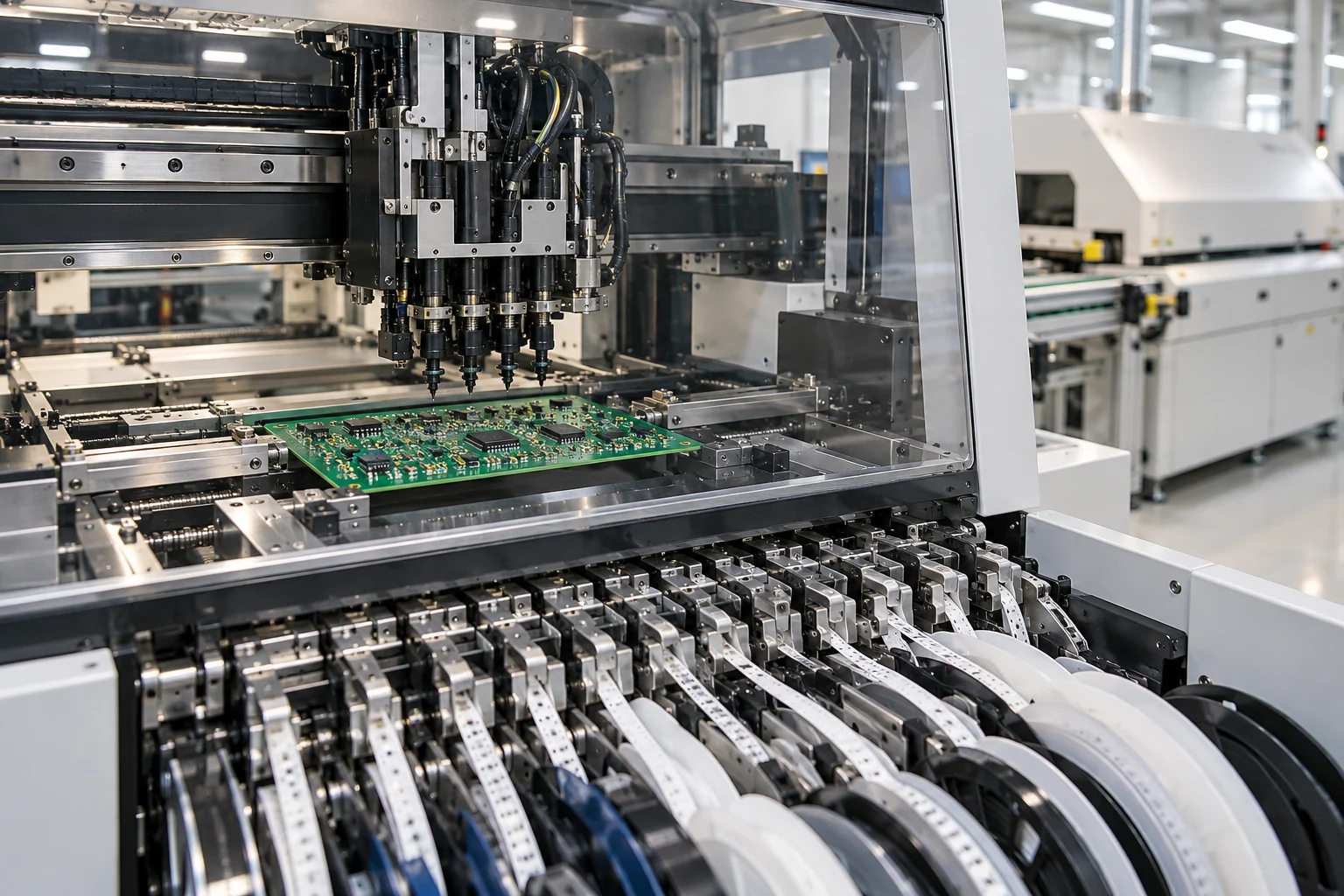
At the pick-and-place stage, retain the approved programme revision and the component-to-feeder assignment relevant to the build. Where the equipment exposes useful records, include pickup errors, rejected components, feeder changes and nozzle-related events. Confirm what each event means before turning it into a loss or defect category.
A repeated pickup error may justify checking material presentation or equipment condition. It does not prove that a defective component reached the board. Similarly, a completed placement cycle does not independently verify part identity. Ask which setup checks and inspection records support each conclusion, and distinguish equipment recovery from accepted production output.
Distinguish the oven recipe from the board's thermal profile
Analog Devices notes that temperatures at solder joints can differ from reflow-system settings, and that board design and component surroundings matter when checking profiles. An oven recipe therefore describes a commanded setup; a measured profile provides evidence about the assembly's temperature history under the evaluated conditions.
Retain the approved recipe revision, relevant conveyor settings and the applicable profiling record. Ask the process engineer when changed assemblies, materials or loading require another evaluation. Select processing limits from the actual assembly and material requirements. An unrelated application note cannot qualify the process.
Sources: [1]
Investigate a pattern across the operations
Hypothetical example: a controller-board line sees more solder-related inspection calls after a product changeover. The review joins board identities with print measurements, placement events, oven recipe history and the inspection programme revision. It also separates confirmed defects from calls cleared through the approved review process.
A change in paste measurements appears during the same period, but that coincidence is a lead to examine. The team checks material handling, setup verification and measurement consistency before selecting an authorised trial. It preserves held-board decisions separately from the investigation, so uncertainty about cause does not erase the obligation to control affected product.
Give the next action a clear owner
Choose one recurring issue and identify the records needed to distinguish its plausible explanations. Include the person responsible for the process, someone who operated the line and the quality owner. Note missing observations honestly; an unreadable panel identity is an information gap, not proof that the board skipped an operation.
After any approved change, compare equivalent products and retain the previous baseline. Review accepted output, inspection findings and extra handling together. A faster local cycle can still leave more work downstream. VIEOX welcomes a discussion around one such operating question and the records already available to help answer it.
Put the question to work
A practical checklist
- Preserve panel, board and side identities across the route.
- Link product revisions with approved equipment programmes.
- Retain paste, stencil and placement setup context.
- Distinguish an oven recipe from a measured thermal profile.
- Separate inspection calls, confirmed defects and disposition decisions.
- Review an authorised change against a comparable baseline.
Questions, answered
Does every machine need to be connected before a review can begin?
No. Start with one question and use verified exports, inspection records and operator notes where necessary. Document how identities and times were matched. A smaller traceable record is more useful than a broad collection whose relationships are uncertain.
Should process limits be changed whenever inspection calls increase?
First establish whether the change reflects the product, the process or the inspection setup. Changes to approved programmes and limits need the site's engineering and quality controls. Reducing calls alone is not evidence that the underlying assembly process improved.
Can this record replace product acceptance testing?
No. Process history helps explain how the assembly was made. Acceptance still depends on its applicable requirements and approved inspection and test plan, including the electrical or functional checks needed for the product.