


Robotic welding · A closer look
Understand friction stir welding through the whole joint.
Explore friction stir welding with tool and fixture identity, operating context, robotic-system considerations, joint traceability and quality review.
The practical question
How can OT information support a friction stir-welding review?
It can connect the joint and workpiece with the relevant tool, fixture, programme, operation history and examination result. For robotic installations, it should also preserve the equipment context needed to interpret the work. The aim is a traceable engineering discussion, with process observations and acceptance kept distinct.
Friction stir welding calls for a different conversation from fusion welding. A useful review follows the joint, tool, fixture and recorded operation together, while preserving what the available process observations can and cannot establish about the finished work.
Recognise the solid-state joining process
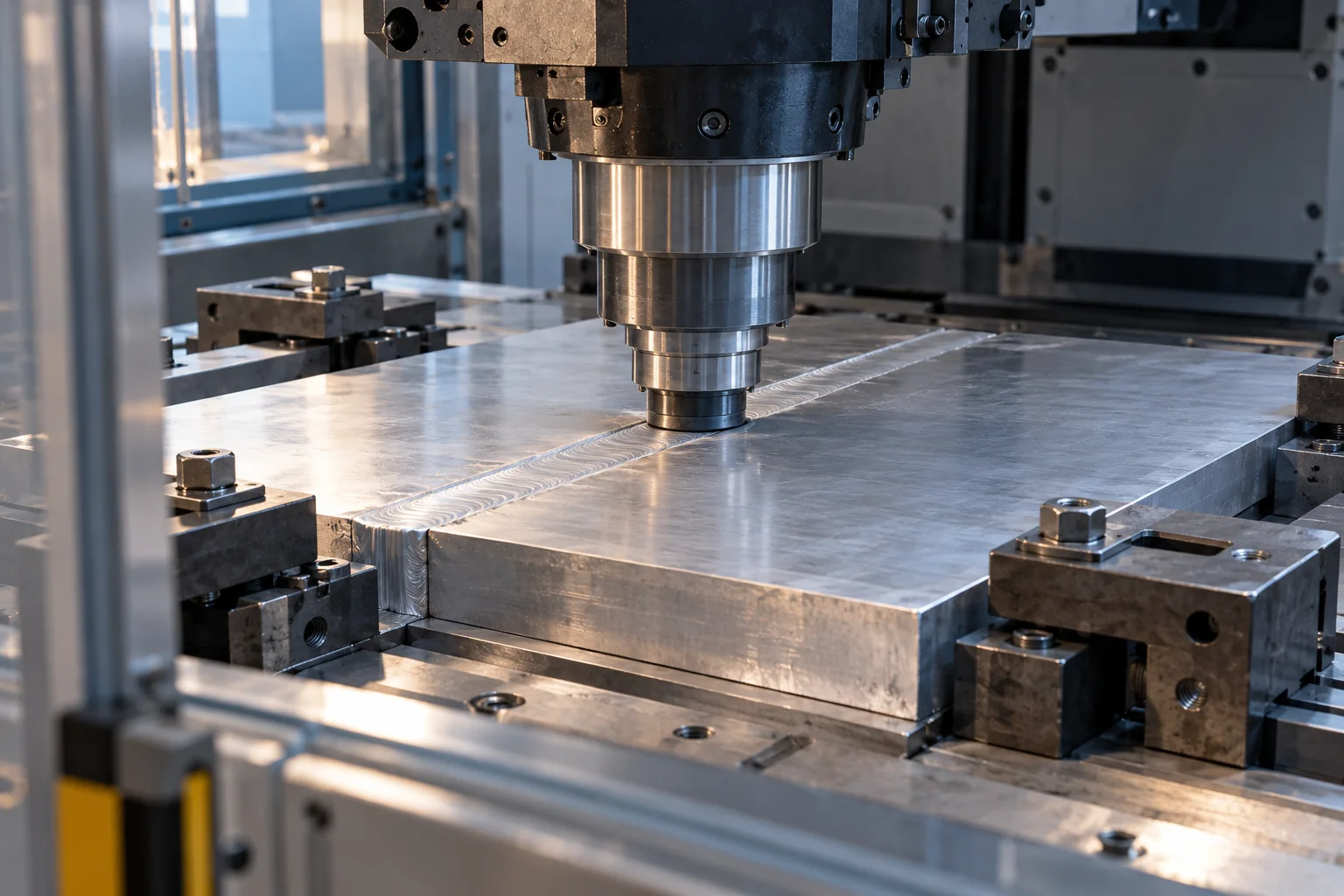
Friction stir welding (FSW) uses a rotating tool to generate heat and mechanically work the joint while the material remains in the solid state. It should not be described as an arc process or a process that relies on melting the joint. That distinction changes the operating information a specialist needs.
Sources: [1]
Include the robot and supporting arrangement
TWI describes robotic friction stir welding as an in-contact operation whose forces act between the machine and component. The robotic system must be suitable for those loads and its stiffness matters to the application. The tool, robot arrangement and support of the work therefore belong in the process context.
Sources: [2]
Give tool and operation history a place
A TWI monitoring study recorded forces, torque and tool temperature during friction stir welding. Those are examples of process observations, not a universal measurement requirement or a ready-made acceptance rule. Select available information around a defined engineering question and the scope in which it has been validated.
Sources: [3]
An illustrative situation
Follow the specific joint through its record
Agree how the team identifies the workpiece, joint path, tool and relevant programme revision. Preserve the actual sequence of attempts and the reference to any approved rework. A completed programme should not hide a pause, interrupted segment or uncertainty about which joint a trace represents.
Hypothetical example: a concern is found after a fixture change. The team first establishes the affected joint references, the recorded change period and the examination coverage. It compares only work for which the relevant material, geometry and setup are understood. The fixture change remains a candidate explanation until the specialist review establishes what the evidence supports.
Make the next review easier to complete
Keep the outcome connected to the original concern: what was examined, which explanation was supported, what remains uncertain and who owns the follow-up. Preserve corrected identities without erasing the reason for the correction. A future reviewer should be able to understand the decision without relying on the memory of one person.
An initial discussion with VIEOX can start with a single joint review that takes too long to assemble. Bring the available production, tool, fixture and quality records and explain which question the team is trying to answer. Together we can identify the information gap and a focused way to assess whether a clearer connection improves the work.
Put the question to work
A practical checklist
- Identify friction stir welding accurately as a solid-state joining process.
- Connect the workpiece, joint path, tool, fixture and programme reference.
- Preserve interruptions and repeated attempts as distinct parts of the history.
- Use process observations within their established measurement and interpretation scope.
- Retain examination findings, specialist decisions and follow-up responsibility.
Questions, answered
Can any industrial robot perform friction stir welding?
Robot selection depends on the forces and stiffness required by the particular application, along with the complete tooling and support arrangement. Treat suitability as an engineering assessment. A general-purpose robot’s ability to follow a path does not establish its suitability for this joining process.
Sources: [2]
Is a process trace the same as a finished-joint examination?
They answer different questions. A trace describes recorded conditions during the operation, while an examination assesses specified characteristics of the completed work. Their relationship must be established for the application, with the scope and uncertainty visible to the quality team.