


Robotic welding · A closer look
Give robotic arc welding a traceable operating story.
Connect robotic arc welding records with joint identity, programme changes, consumables, interruptions and inspection without confusing a cycle with acceptance.
The practical question
Which information makes a robotic arc-welding review more useful?
Begin with the part and joint, identify the joining process and programme revision, and preserve the sequence of welding attempts and interruptions. Connect the available process observations with consumable or maintenance records and the relevant inspection. Ask a qualified welding specialist to interpret the relationship.
For an arc-welding review, the useful unit of investigation is often a particular joint or portion of a joint. Relating that work to the programme, equipment history and examination result makes the discussion more precise than reviewing a shift total alone.
Name the arc process clearly
Arc welding is a family of fusion processes. Gas metal arc welding (GMAW), commonly described as MIG or MAG, uses a continuously fed wire electrode and shielding gas. Gas tungsten arc welding (GTAW), or TIG, uses a non-consumable tungsten electrode. A useful record identifies the process instead of treating every arc-welding signal as interchangeable.
Sources: [1]
Keep the equipment context close
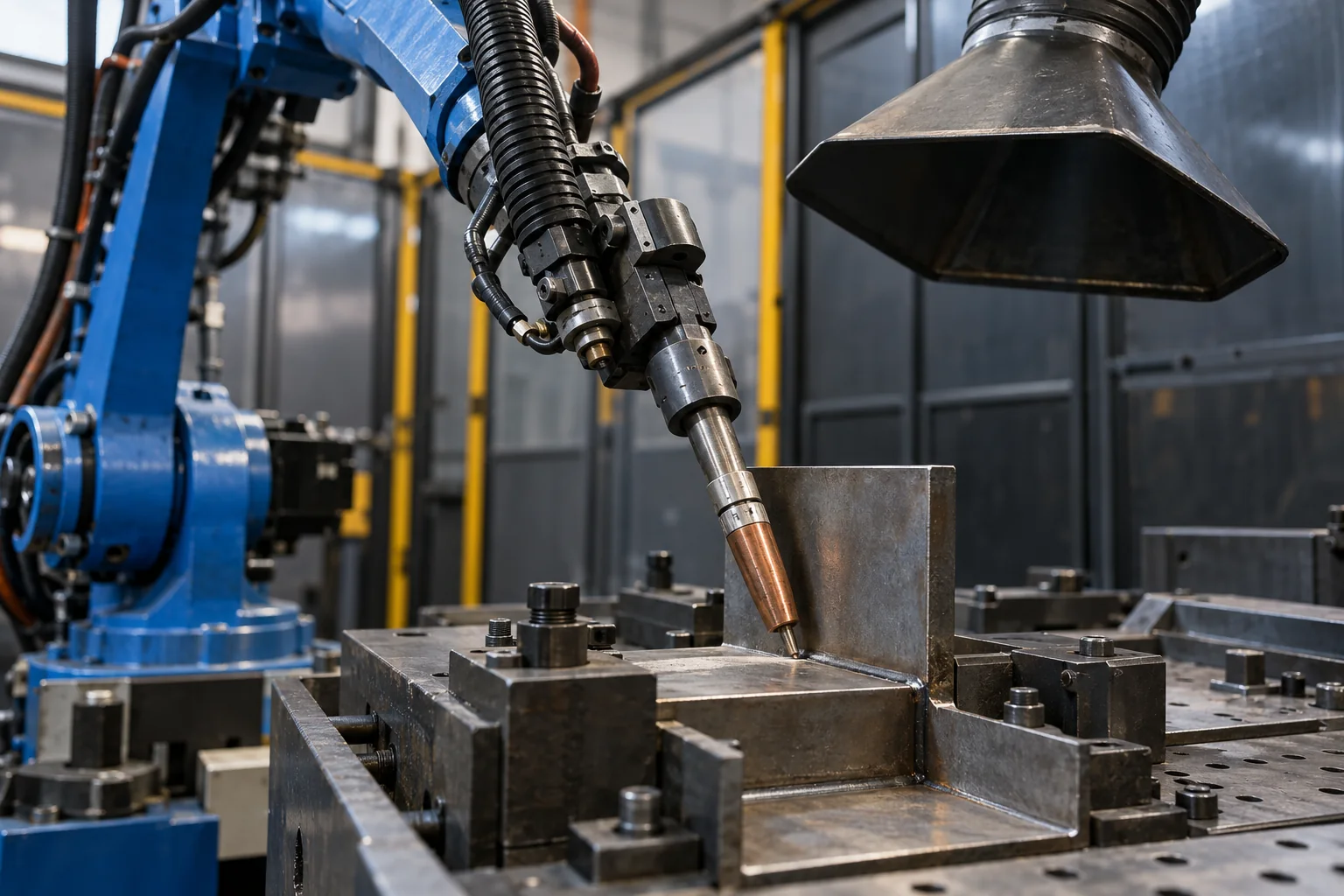
TWI describes the wire feed, contact tip, power source and gas supply as connected parts of gas metal arc welding. A process review should therefore be able to locate the relevant equipment and consumable history, alongside the robot programme, without assuming that a changed signal has a single cause.
Sources: [2]
Separate attempts, interruptions and completed work
Agree what the recorded start and finish represent. Does the start identify a programme command, the beginning of the joining operation or another equipment event? If a cycle stops and resumes, preserve the interruption and the subsequent attempt. A single duration can hide the sequence the welding engineer needs to understand.
Use joint references that remain readable to the inspection team. When one programme contains several welds, a programme-level record may be too broad for a local finding. Ask whether the available events can establish the relevant segment. If they cannot, state the limit rather than assigning a precise time to an uncertain joint.
An illustrative situation
A recurring concern after a changeover
Hypothetical example: an assembly requires more attention after a product changeover. The team collects the affected joint references, loading period, programme revision and relevant inspection findings. It also locates the recorded torch service and consumable change. Nothing is labelled as the cause simply because it occurred near the first finding.
A comparable earlier run provides a reference only after the team checks the assembly, joint requirement and examination coverage. The next question may be whether the recorded work really belongs to the same setup. A precise review can avoid spending the first meeting debating which records everyone is looking at.
Make the review useful beyond one shift
Preserve what the welding specialist concluded, which observations supported the conclusion and what remains to be checked. Link authorised follow-up to the concern so the next shift can see the reason for the work. Equipment alerts and operational summaries should direct attention to the right review; they should not silently approve a process change.
For a conversation with VIEOX, bring one recurring joint concern and the records currently used to investigate it. We can explore where the information loses its identity or context, and what a clearer connection would help production, maintenance and quality understand. The starting point can be small enough for the people involved to assess its value honestly.
Put the question to work
A practical checklist
- Record the exact arc-welding process and the relevant joint identity.
- Distinguish an initial attempt, interruption, restart and later rework.
- Preserve the programme revision and relevant equipment or consumable history.
- Relate the findings to the examination coverage and applicable requirement.
- Record the specialist’s conclusion and the owner of any follow-up.
Questions, answered
Should every available electrical signal be collected first?
Start with the review question and establish what the existing signals mean, their timing and their connection to the joint. Additional collection is useful when it fills a defined gap. A large dataset without that connection may still leave the team unable to explain a particular concern.
How should an uncertain joint-to-cycle connection be presented?
Show the possible period and the reason for uncertainty. Do not attach a precise weld record solely because it is the closest timestamp. Identify what could establish the connection and whether the existing inspection or production records can help.