


Oil & Gas · A VIEOX perspective
Read the machine in the context of its duty.
A practical guide to reviewing oil and gas rotating equipment: operating duty, utility context, recent work and the questions behind a changed reading.
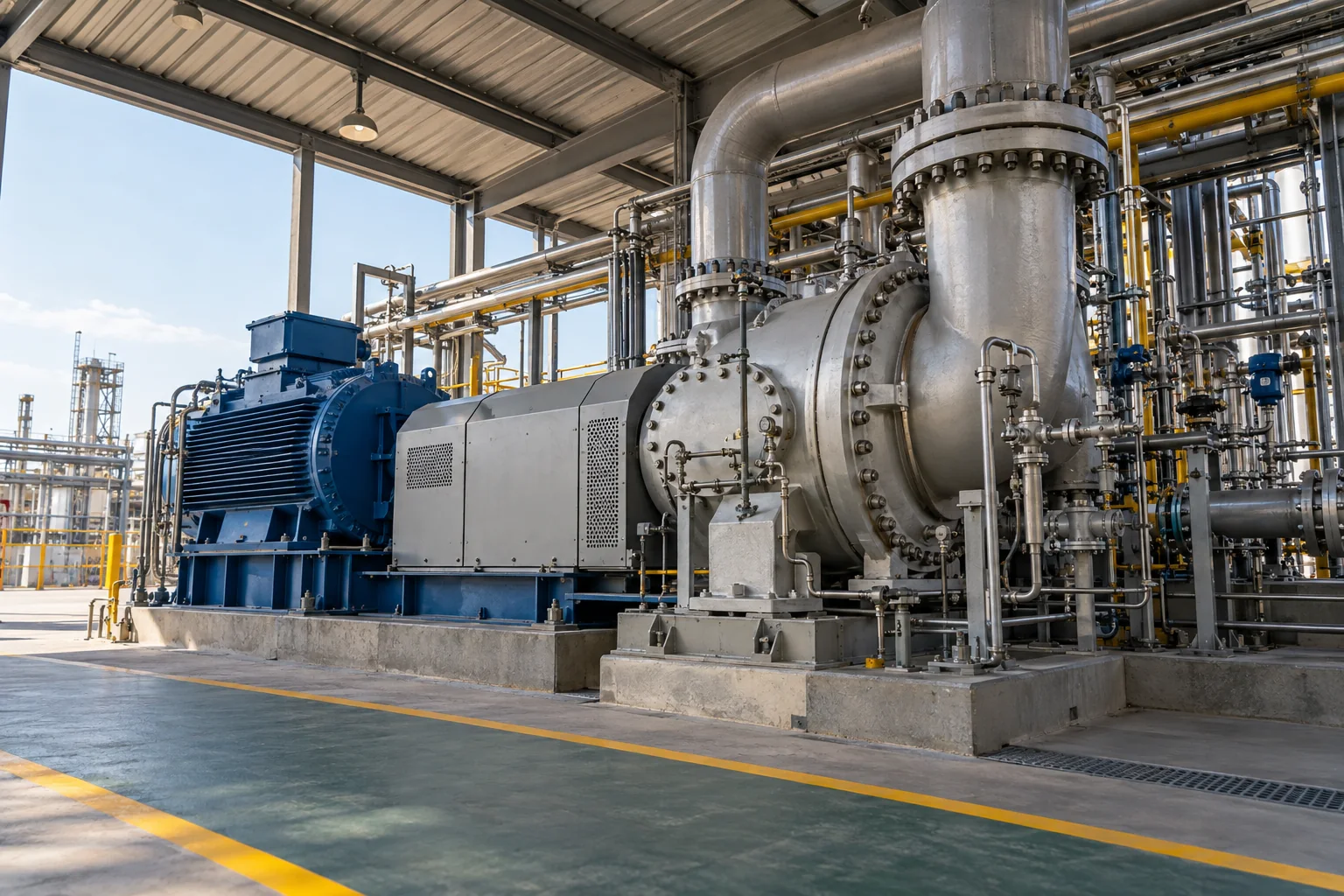
The practical question
What should accompany a rotating-equipment trend during a review?
The exact equipment and measurement point, its operating duty, the relevant process or utility conditions, recording quality and recent inspection or maintenance work. These give the responsible team a clearer basis for deciding what to examine next.
A pump or compressor can generate a detailed history while still leaving the reviewer with a basic question: what was this machine being asked to do at the time? Equipment information becomes more useful when that duty stays alongside the reading.
Begin with the service the equipment provides.
Identify the machine and the process or utility service it supports. Record whether the question concerns a particular operating period, repeated starts, an observed vibration change or a temperature trend. Keep the equipment reference precise enough to distinguish parallel machines and measurement locations.
The Department of Energy's pumping sourcebook frames performance around the interaction of supply and demand across a system. Applying that perspective to a review means asking about the duty around a reading, not treating the pump as an isolated object.
For a compressor or another rotating asset, use the corresponding equipment documentation and the site's specialist knowledge. The purpose of this guide is to organise the review question, not to transfer one machine's assessment method to a different design.
Sources: [1]
Choose a recording window that answers the question.
Locate the period in which the change was observed and enough surrounding information to understand its sequence. Check whether the machine was starting, stopping or operating under a different duty. If the available record cannot distinguish these conditions, keep that limitation visible.
Ask when each value was measured and how it was recorded. A routine observation, a sampled trend and an event entry may describe different times or levels of detail. Before comparing them, establish which time reference the team is using and whether any recording changes could affect the apparent pattern.
Bring the maintenance history into view.
HSE's maintenance guidance includes identifying the relevant equipment, assigning responsibility and recording, tracking and trending maintenance information. These are useful foundations for an equipment review that another person can follow.
Find the work and inspection records that belong to the selected machine. Ask what was examined, what was actually found and which questions remained open. Keep a completed task distinct from an accepted finding or a decision about equipment availability.
If contractor and site teams have used different equipment names, resolve the mapping before combining their histories. A record connected to the wrong parallel machine can be worse than a clearly labelled gap. Preserve the original reference so a later reviewer can understand how the connection was made.
Sources: [2]
An illustrative situation
A recurring temperature question.
Hypothetical example: a utility pump has a higher recorded bearing temperature during several operating periods. The first suggestion is that recent maintenance did not resolve the concern. The reviewer asks for the equipment reference, relevant work findings and the duty during each period.
The assembled record shows that the selected comparison includes a different operating pattern and that one manual note refers to the adjacent pump. The team corrects the record association and keeps the remaining temperature concern open for assessment. It does not infer that the concern has disappeared.
The useful outcome is a more precise question with an identifiable evidence set. The responsible maintenance and operations personnel decide the next step through their approved process. No generic temperature limit or maintenance instruction can be inferred from this illustration.
Give competing explanations a fair examination.
Write possible explanations as questions that can be checked. Could the difference relate to duty? Was the observation taken at a different location? Is there evidence of a recording problem? Does relevant inspection information support an equipment concern? The aim is to organise the assessment, not to create a list that substitutes for engineering judgement.
Include information that does not fit the favoured explanation. If similar operating periods show a different pattern, that exception deserves attention. If no fair comparison exists, the team can define what further observation is required rather than presenting an unsupported trend as a diagnosis.
Make the next review easier to prepare.
A useful review closes with the observation, the supporting records, the remaining uncertainty and the person responsible for assessing it. Keep that compact account linked to the detailed history. It should be possible to return to the same question without rediscovering which equipment and period were discussed.
This is a concrete starting point for a discussion with VIEOX. Tell us where equipment context becomes hard to assemble and which team needs the result. We can explore the information scope and what a first assessment would need to show, while respecting the site's equipment and operating responsibilities.
Put the question to work
A practical checklist
- Confirm the equipment identity, measurement location and service.
- Identify the operating duty during the period of interest.
- Check recording intervals, time references and measurement changes.
- Connect relevant inspection findings and completed work accurately.
- Keep the unresolved question and responsible reviewer visible.
Questions, answered
Can equipment trends be compared across parallel machines?
They may provide a useful line of enquiry, but first establish whether the design, measurement locations, duty and records are comparable. Treat differences as questions for the responsible specialist rather than assuming identical behaviour is expected.
Does this require an automated diagnosis?
No. A clear equipment history and operating context can already help people formulate a better assessment question. Any later diagnostic method would need its own evidence, evaluation and agreed use.