


Industry overview
Oil and gas operations, connected from field to delivery.
An introduction to oil and gas segments, equipment and processes, their operating challenges, and how OT connects production, maintenance and environmental context.
The practical question
How can OT address oil and gas challenges across the operating chain?
By connecting measurements, controls and equipment history with the operating area they serve. A coherent view can support continuity, maintenance planning, resource use and investigation, with qualified people retaining responsibility for process changes and protective systems.
Oil and gas turns underground resources into fuels and industrial feedstocks through a chain of production, processing, transport and storage. Each part has its own equipment and responsibilities. Operational technology helps teams see and control the physical operation while retaining the process, asset and human context behind each decision.
An industry with three connected segments.
Upstream covers exploration and production at onshore and offshore fields. Midstream gathers, processes, stores and transports hydrocarbons. Downstream refines and distributes fuels and other petroleum products. These boundaries can overlap: gas treatment, for example, may sit alongside field production or within a separate processing business.
The useful industry picture follows both the material and the responsibility. A field operator, compressor station, refinery and terminal contribute to the same supply chain but have different priorities. Understanding those differences is the foundation for deciding what information should be shared.
Sources: [1]
Equipment and processes change along the chain.
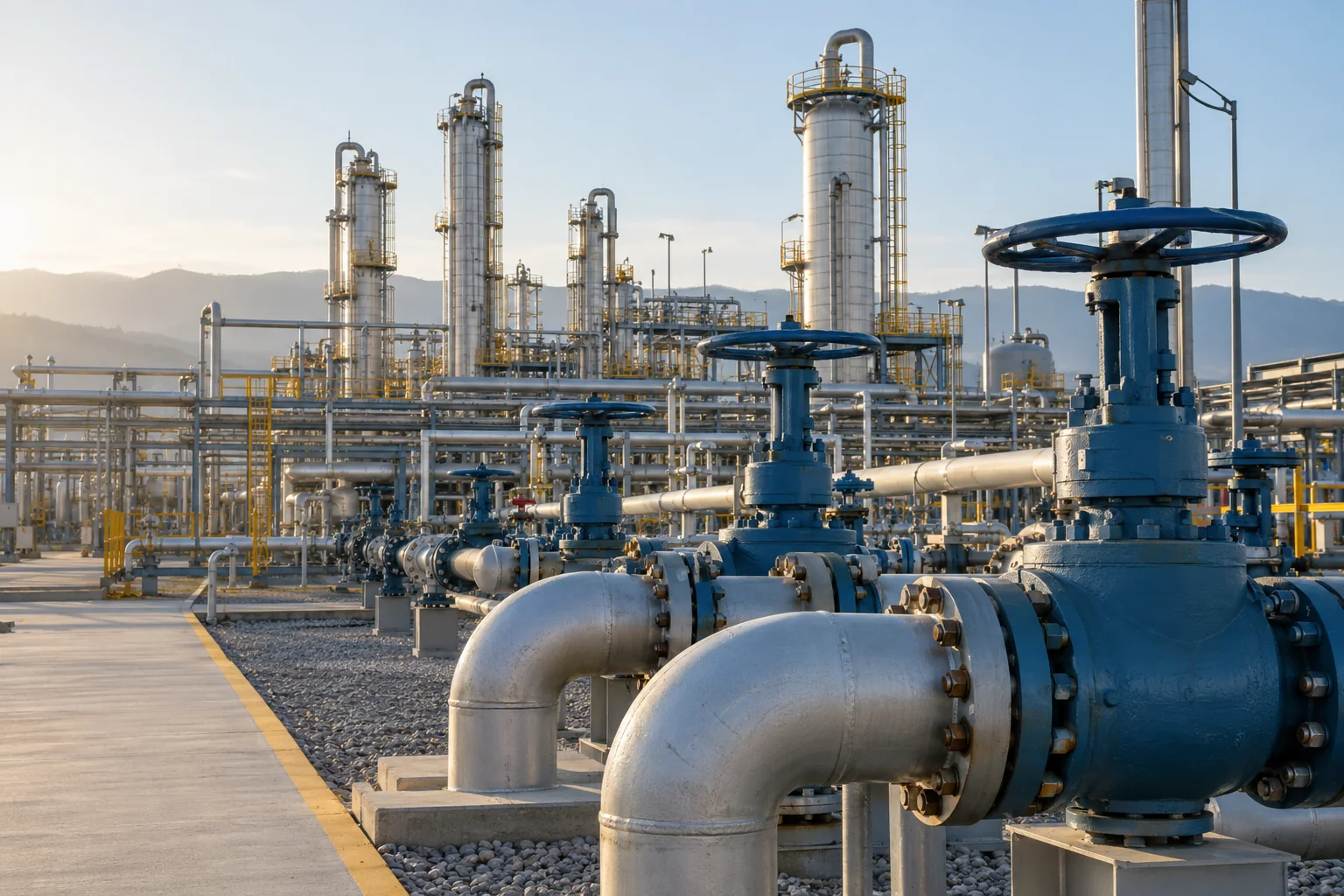
Wells feed separation and treatment equipment; pumps and compressors move fluids; pipelines and tanks connect processing with delivery. Refineries use furnaces, distillation columns, reactors and heat exchangers to separate, convert and treat crude oil. Blending, storage and loading then prepare products for their next destination.
Steam, cooling, electricity, instrument air and water treatment support the main process. An equipment list becomes more useful when it shows the service provided and the nearby operations that depend on it. The appropriate OT scope therefore follows a process area and its supporting services.
Reliability, containment and resources are linked challenges.
Teams need to sustain production while managing equipment deterioration, planned shutdowns and changing operating duties. Remote assets make local observations harder to obtain, while disconnected records can slow the review of recurring concerns. Energy consumption, water use and product losses also need to be understood against the work actually being done.
Emissions monitoring adds another information need. NETL research examines sensing across gas production, processing and transport, including compressors, valves and storage. Measurement quality and the circumstances around an observation matter when a team decides what requires investigation.
Sources: [4]
OT connects the physical operation with its people.
Sensors, controllers, supervisory systems and operating histories provide the means to monitor and control equipment. Their practical value grows when measurements carry a clear asset identity, time and operating state. Connecting those records with maintenance activity and shift observations helps production, engineering and environmental teams work from a common account.
A broad operating view should explain where a concern sits, who is reviewing it and what evidence remains incomplete. It can shorten the path from observation to informed review while leaving the technical judgement with the people responsible for the operation.
Improve the whole service, with clear boundaries.
Treat reliability, production continuity and resource use as connected objectives. A more complete pump or compressor history can support a maintenance discussion; a process view can show when the same asset was serving a different duty. Comparing those perspectives helps avoid improving one local indicator while obscuring a wider operating constraint.
Information access, cyber resilience and change control belong in the design from the beginning. Plant controls and protection retain their defined responsibilities. Any new connection or proposed control change needs the appropriate engineering assessment, including how the operation continues if information becomes unavailable.
Start with one recurring industry challenge.
A useful starting point is a concern shared by several teams: recurring compressor interruptions, unclear utility consumption or an operating issue that loses context between shifts. Map the process area, the people involved and the records needed before selecting an interface or dashboard.
Agree what a clearer account would enable the team to do, and how that result will be judged. VIEOX can use this context to explore an appropriate ConverEDGE scope. Deeper equipment and operating perspectives are available through the Oil & Gas Insights linked alongside this overview.
Put the question to work
A practical checklist
- Identify the segment, process area and supporting services.
- Connect the equipment concern to production and environmental context.
- Include operations, maintenance and instrumentation in the review.
- Agree data access, ownership and change responsibilities.
- Evaluate the result against one recurring operating question.
Questions, answered
Does every oil and gas facility need the same OT approach?
No. A field, pipeline station, refinery and terminal have different processes and responsibilities. The starting scope should reflect the actual asset, service and people involved, then connect with the wider chain where that is useful.
Can a shared operating view decide whether equipment is safe to run?
A shared view can support a qualified assessment by bringing relevant evidence together. Operating authority and protective functions remain with the established site arrangements; a summary or trend does not establish equipment fitness by itself.