


Industry overview
Connect chemical production, equipment and operating responsibility.
A broad introduction to chemical and petrochemical segments, equipment and processes, major operating challenges, and how OT supports connected production and asset decisions.
The practical question
How can OT address chemical and petrochemical operating challenges?
By connecting measurements and control with the process unit, material, equipment history and responsible teams. This can support steadier operations and more informed review of quality, maintenance and resource use, within the plant’s established protection and change-management arrangements.
Chemical and petrochemical manufacturing turns raw materials into ingredients and products used across industry and daily life. The sector spans large continuous plants and flexible batch operations. Operational technology helps connect process conditions, equipment and people so that reliability, product consistency and resource use can be considered together.
A broad sector with different production models.
Basic chemicals supply building blocks for other industries; specialty chemicals serve particular applications such as coatings and adhesives. Agricultural chemicals, industrial gases, polymers and formulated consumer products add further segments. Petrochemical production connects oil and gas feedstocks with chemical intermediates and materials.
Large-volume products often use connected continuous units, while other plants organise production in batches or campaigns. A site may combine both. Understanding the product family, material route and operating model helps establish which information belongs together and which comparisons would be misleading.
Follow the process through its equipment.
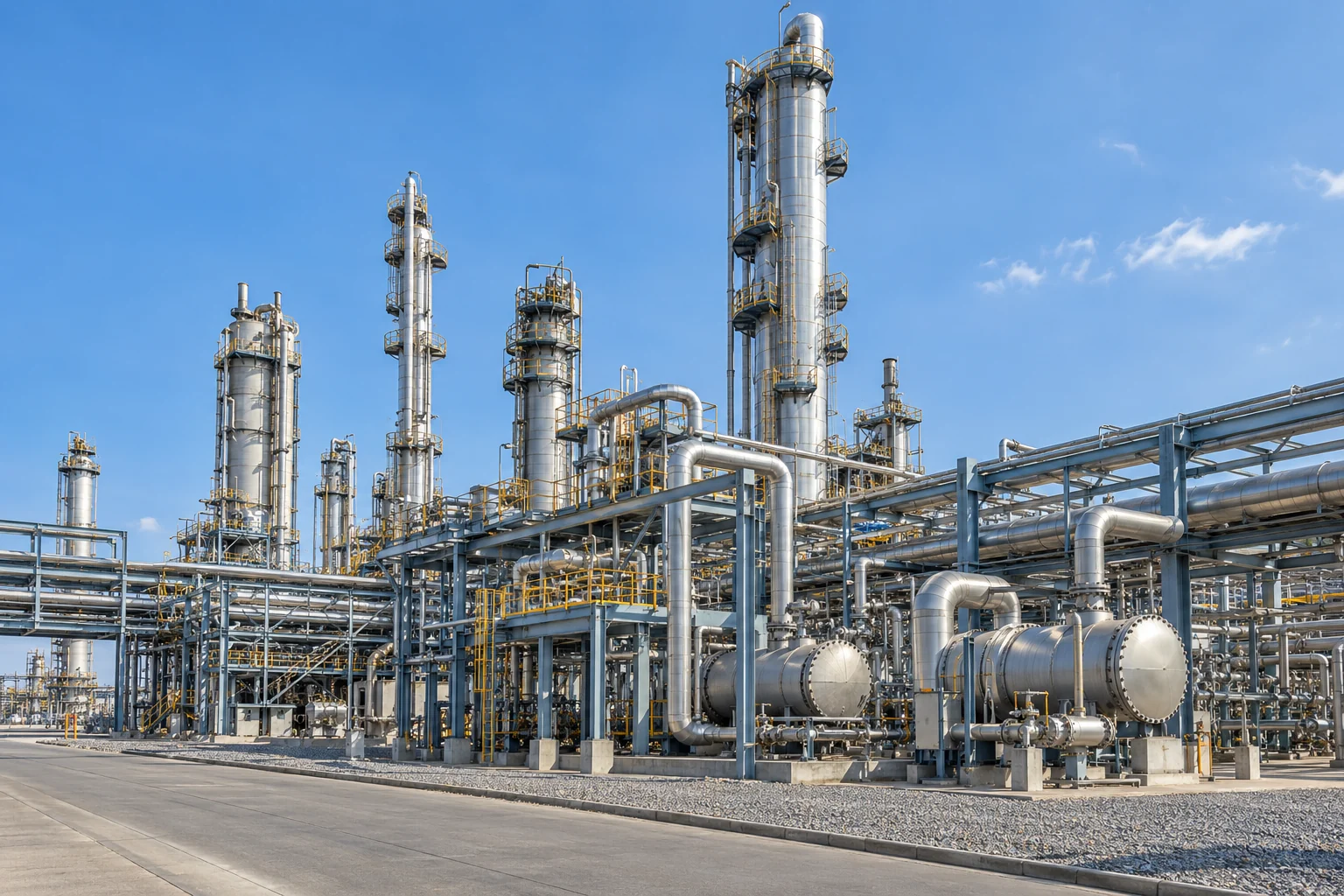
A broad process route may include feed preparation, reaction or blending, separation, purification, product finishing and storage. Reactors, mixing vessels, furnaces, distillation columns, heat exchangers, filters, pumps and compressors perform different duties along that route. The specific equipment depends on the product and chemistry.
Hydrocarbon feedstocks illustrate the connection with other industries: EIA describes their use in petrochemical production, including materials that become plastics and other products. Within a plant, the useful operating picture follows a defined unit and its upstream and downstream dependencies, rather than treating every measurement as an isolated signal.
Major challenges cross process and asset boundaries.
Plants need consistent product quality and dependable equipment while handling feedstock variation, fouling, wear and changes in operating duty. Continuous operations must coordinate interruptions across connected units; batch plants must manage transitions between products. An equipment concern can therefore also become a production or quality question.
Energy and utility performance matter throughout this picture. Australian government guidance highlights the role of steam, distillation, motor systems and heat recovery in chemical manufacturing. Comparing consumption with the process and throughput can help teams examine resource use without losing sight of the product being made.
Sources: [3]
OT connects observation, control and operating context.
OT includes instruments, actuators, process and sequence controls, operator interfaces and histories. HSE describes monitoring, information, normal process control and protective functions as distinct responsibilities within instrumented systems. Keeping those roles explicit helps teams understand what a new connection or information view is intended to support.
Linking process measurements with material, equipment and operating-state references can improve reviews across production, quality and maintenance. The useful result is a coherent account of what was observed and under which conditions. Interpretations and unresolved questions should remain visible alongside the data.
Sources: [4]
Improve the whole operation within its engineering boundaries.
A holistic approach considers throughput, product quality, asset care and utility use together. Better visibility can help teams recognise repeated interruptions, examine process variation and prioritise maintenance questions. The benefit depends on the actual process relationships, suitable measurements and the people who act on the information.
Cybersecurity, instrument reliability, access responsibilities and change control belong in the operating design. Existing protective systems retain their defined independence and purpose. An information project should respect those boundaries and make clear which functions only observe the process and which could affect it.
Sources: [4]
Begin with a recurring unit-level concern.
Choose a challenge that crosses team boundaries: an unexplained interruption, inconsistent energy context or an equipment issue that repeatedly returns during a production campaign. Identify the unit, operating period and records needed to understand it. Involve the people who own the process, instrumentation and work history.
Agree what the improved view should enable, and review its usefulness against that objective before extending the scope. VIEOX can explore where ConverEDGE fits the information need. Chemical & Petrochemical Processing Insights alongside this page offer deeper discussion of process conditions and mechanical integrity.
Put the question to work
A practical checklist
- Identify the product family, process unit and production model.
- Connect equipment duties with upstream and downstream dependencies.
- Review quality, maintenance and resources together.
- Define information access and control boundaries.
- Assess one recurring concern with the responsible plant teams.
Questions, answered
Is OT relevant to both batch and continuous chemical production?
Yes. Both use measurements and control, but material identity, process stages and operating transitions differ. The information should follow the actual production model and its review responsibilities.
Can a connected information view replace protective systems?
No. It can support observation and informed review. Protective functions and authority for process changes remain within the plant’s engineered arrangements and responsible teams.